
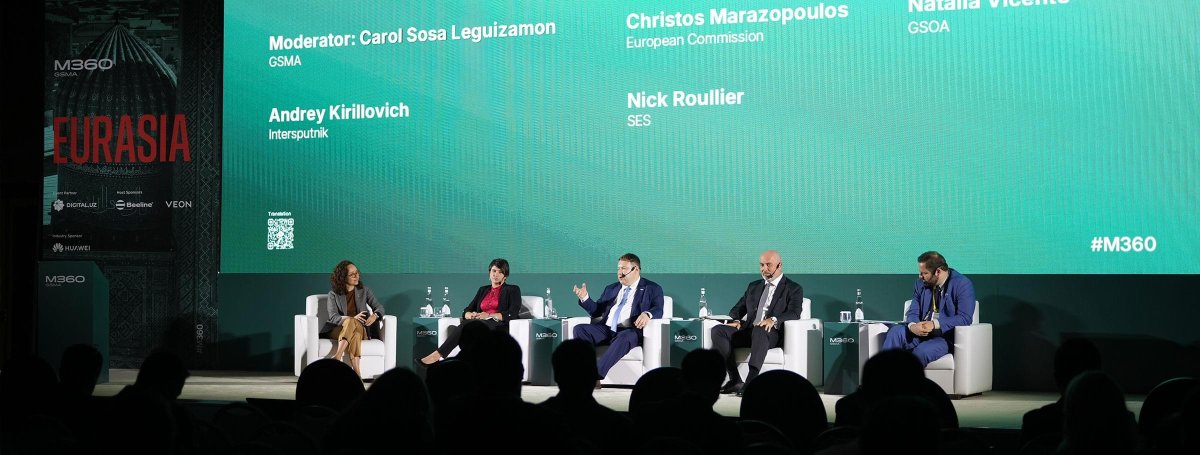
Intersputnik participated in the event. Andrey Kirillovich, Director of Strategy, Marketing and Business Development at Intersputnik, together with representatives of the Global Satellite Operators Association (GSOA), the European Commission and SES, took part as a speaker in the first-day panel discussion "New Horizons: Communications for All”. The panel was moderated by GSMA and addressed the issues of sustainable and efficient use of the available radio frequency spectrum to connect remote and hard-to-reach regions.
GSMA is the largest industry association in the telecom segment, uniting nearly 1,000 members from across the globe, who are the key players in the mobile communications market. It is mobile communications that currently determines how the telecom market will develop in the near future. GSMA organises the world's largest annual communications industry exhibition and conference, the Mobile World Congress (MWC) in Barcelona. The association also holds annual regional conferences, including Eurasia.
The conference was attended by representatives of mobile network operators from Central Asia and the Black Sea region, international satellite operators, international and national regulators, telecommunications administrations, telecom operators, vendors and service providers from countries of the region, as well as from Europe, the Middle East and South Asia.
Attendees expressed a particular interest in the topic of frequency distribution between terrestrial mobile networks and direct-to-device (D2D) satellite networks, as well as the need for strict spectrum regulation and licensing to ensure the coexistence of all services. The accelerated adoption of D2D technology in Central Asia and other regions highlights the need to understand its strengths and weaknesses to expand coverage, as well as to develop mechanisms to ensure the coexistence of different services.
In his speech at the panel, Andrey Kirillovich noted the strengthening of satellite communications, their inclusion in the 5G 3GPP standard, as well as their growing role in the digital ecosystem through new technological advances, such as the development of non-geostationary constellations. This is especially relevant for Central Asian governments, who can leverage the synergies of satellite and terrestrial mobile communications to bridge the digital divide.
Andrey Kirillovich emphasised the importance of creating an adequate regulatory framework that takes into account global experience in implementing satellite services, while also meeting the interests and specific needs of both satellite and terrestrial technologies, as the most important task. The upcoming World Radiocommunication Conference 2027 (WRC-27) will consider adopting principles to enable satellite and terrestrial networks to operate together without interfering with each other.
Developing a sound regulatory framework, managing the projects to eliminate the digital divide and distributing frequencies in a way that takes into account the interests of all industry players, all this require qualified personnel. Mr. Kirillovich briefed the conference attendees on Intersputnik's initiatives to support young professionals and strengthen the industry's human resources. He also spoke about training seminars on satellite regulations and technologies held in Intersputnik Member States in collaboration with the International Telecommunication Union. The next such event will be held in the Kyrgyz Republic in Q3 2026.