
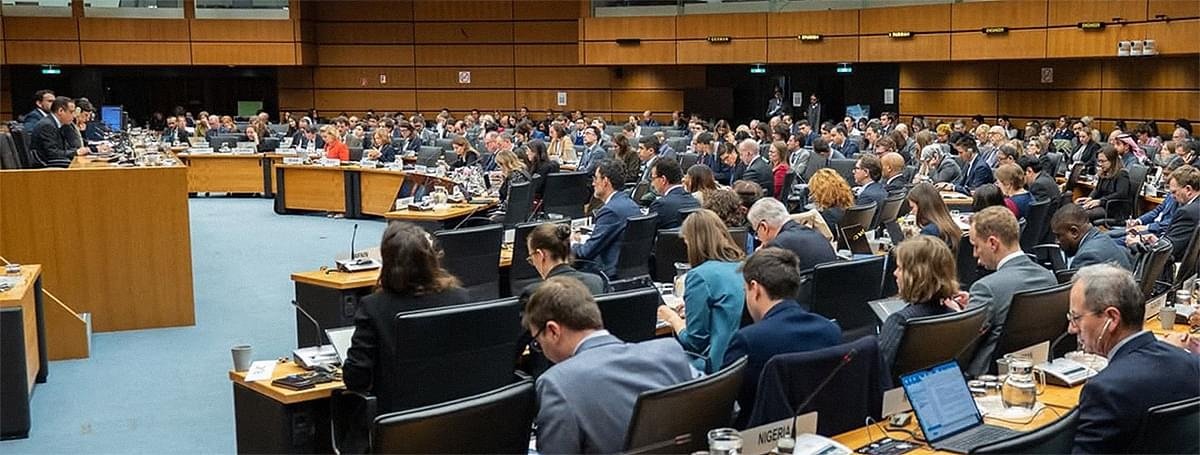
Today, the Committee unites over one hundred states as its members and dozens of intergovernmental and non-governmental organisations as its permanent observers. The session, chaired by Mr Pablo Adrián Arrocha Olabuenaga (Mexico), ran alongside working group meetings and thematic events organised by Member States and observers.
During the session of the Legal Subcommittee, Intersputnik presented statements and conference room papers on two agenda items approved by UN General Assembly resolution 80/76 of 5 December 2025. Under agenda item 5, entitled “Information on the activities of international intergovernmental and non-governmental organizations relating to space law”, Intersputnik informed the Subcommittee on its contribution to capacity-building in Member States in the field of space law and policy through active involvement in relevant events, initiatives and discussions promoted by the United Nations, the International Telecommunication Union (ITU) and other international and regional organisations and forums, in particular on issues relating to the long-term sustainability of outer space activities, including the use of radio-frequency spectrum and satellite orbits. Under agenda item 6, entitled “Status and application of the five United Nations treaties on outer space, and ways and means, including capacity-building, to promote their implementation”, Intersputnik shared its experience of accepting the rights and obligations under the UN treaties relating to outer space, as a result of which Intersputnik became the first intergovernmental organisation in history to accept the obligation to comply with the principal instrument of international space law — the Treaty on Principles Governing the Activities of States in the Exploration and Use of Outer Space, including the Moon and Other Celestial Bodies (the Outer Space Treaty).
The activities and experience of international intergovernmental and non-governmental organisations traditionally offer a different perspective on specific aspects of the regulation of space activities, thereby contributing to a deeper insight into international space law and promoting its further study. In this regard, the Legal Subcommittee has repeatedly acknowledged the value of international organisations’ engagement in the exchange of information pertaining to space law, and the need to continue this practice. In addition, the session highlighted the overall importance of taking measures to build and further develop capacity in the field of space law.
Other significant topics from the recent session included issues relating to the nature and utilisation of geostationary orbit, including ways and means to ensure its rational and equitable use without prejudice to the role of the ITU, legal mechanisms to help mitigate and remediate space debris, aspects of space traffic regulation, and the application of international space law to small-satellite activities.
About Intersputnik
Intersputnik is an international intergovernmental organisation founded in 1971. The Members of Intersputnik are the governments of 24 states, which have also appointed 24 Intersputnik Signatories from among communications administrations and organisations of the Member States. Intersputnik’s objective is to promote cooperation in the design, establishment, operation and development of the Intersputnik international satellite telecommunications system.
Since 1985, Intersputnik has held permanent observer status with the Committee on the Peaceful Uses of Outer Space and has been involved in the work of the Committee, its subcommittees and working groups, as well as in the activities of the United Nations Office for Outer Space Affairs, which acts as the secretariat for the Committee. By actively engaging in these forums, Intersputnik is able to keep abreast of developments and trends in the regulation of space activities, take part in relevant discussions, and maintain contacts with Members and Signatories, partner international intergovernmental and non-governmental organisations, as well as other attendees of Committee events.
Photo © UNOOSA