
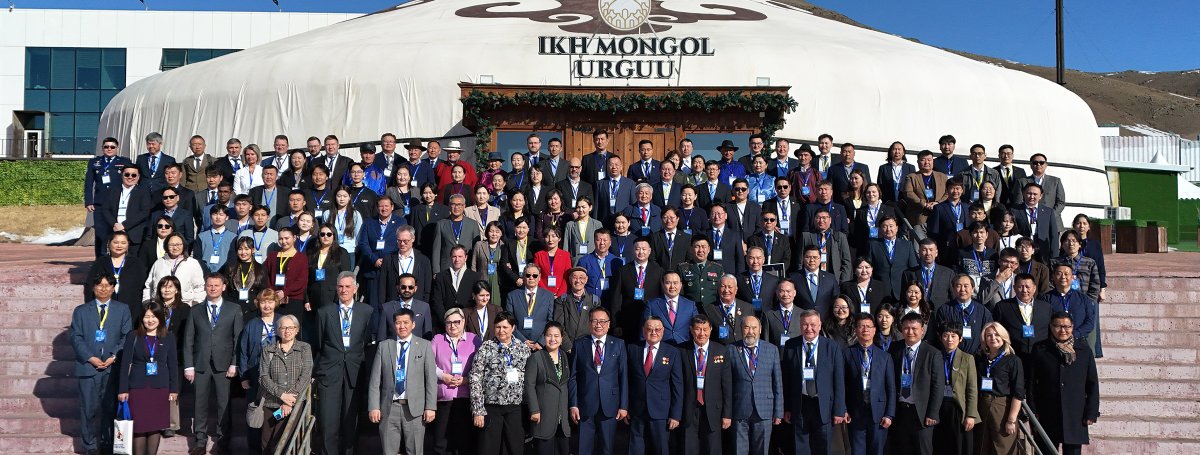
From Mongolian side, the scientific conference was organised by the Mongolian Academy of Sciences, the Ministry of Economy and Development, the Ministry of Digital Development, Innovation and Communications, and the Mongolian Association of Space Technologies. The second co-organiser of the forum was the Asia-Pacific Space Cooperation Organization (APSCO).
An international crew of Soviet cosmonaut V. Dzhanibekov and the first Mongolian cosmonaut J. Gürragchaa performed a successful mission on board the Salyut-6 orbital station on 22–30 March 1981. This flight gave a significant impetus to Mongolia's space industry, which is currently developing a new cosmonaut training programme, building a modern aerospace laboratory for satellite systems, and implementing a project to launch a national communications and broadcasting satellite.
A scientific conference, organised with the participation of Intersputnik, provided an opportunity to analyse achievements and current priorities in the fields of space science and law, the application of space technologies, and the implementation of capacity building programmes in Mongolia. The event also aimed to strengthen international cooperation between the forum's organisers, partners, and attendees, who were given the opportunity to outline joint projects and exchange up-to-date information.
As part of the conference's business programme, Intersputnik organised a session dedicated to space policy, law and capacity building. Intersputnik presented a report on the international Agreement on the Rescue and Return of Astronauts. This strategic document, adopted at the height of the Cold War and space competition in 1967, should become an example of how to resolve important international issues based on respect for common interests and the idea of equal global cooperation. Another topic that Intersputnik representatives raised at the conference was support for young employees from the Organization's Member States and strengthening the industry's human resources potential. Intersputnik's report on the current status and trends of the global satellite market also generated great interest among conference attendees.
Mongolia is one of the first countries to join the Agreement of 15 November 1971 on the Establishment of the Intersputnik International System and Organization of Space Communications. Through the years, Mongolia has continued to actively develop satellite television and radio broadcasting and communications systems, including in partnership with Intersputnik, which consistently adheres to the fundamental principles of open and mutually beneficial international cooperation aimed at using satellite technology to improve people's quality of life.