
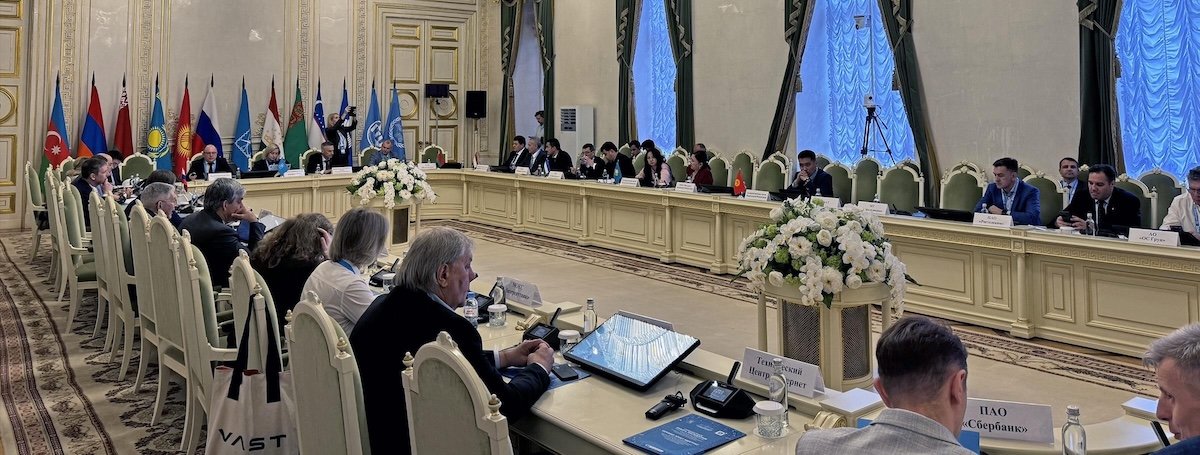
A joint meeting of the RCC Commission on Telecommunications Regulation and the RCC Council of Telecommunications and Infocommunications Operators, as well as a joint meeting of the Board of Heads of Communications Administrations and the Coordination Council of the CIS Member States on Informatization at the RCC were held in Saint Petersburg. In addition, during the Saint Petersburg International Economic Forum (SPIEF), a plenary session “Digital Future: Common Development Vectors, Challenges and Solutions” was organized by RCC.
The high level of discussion at the international plenary session "Digital Future: Common Development Vectors, Challenges and Solutions" was provided by the participation of top officials – heads of communications administrations of the RCC member states. The majority of these countries are members of Intersputnik. еThe speakers at the session were the Minister of Communications and Informatization of the Republic of Belarus Kirill Zalessky, Vice-Minister of Artificial Intelligence and Digital Development of the Republic of Kazakhstan Doszhan Musaliev, Head of the Communications Service under the Government of the Republic of Tajikistan Isfandiyori Sa'dullo, Chairman of the Service for Regulation and Supervision in the Communications Industry under the Ministry of Digital Development and Innovative Technologies of the Kyrgyz Republic Altynbek Toktorbaev, Minister of Communications of Turkmenistan Khadzhymyrat Khudaygulyev, Minister of Digital Development, Communications and Mass Media of the Russian Federation Maksut Shadayev, Minister of Digital Technologies of the Republic of Uzbekistan Sherzod Shermatov. The session was moderated by RCC Director General Alexei Borodin.
The session discussed the region's technological sovereignty in the context of global digitalization and geopolitical instability; procedures required for creating a unified regional and international digital infrastructure; optimal approaches to regulating the digital environment at the regional level; and the promotion of these approaches at the global level.
Later, as part of the events dedicated to the 35th anniversary of the RCC, a joint meeting of the RCC Commission on Telecommunications Regulation and the RCC Council of Telecommunications and Infocommunications Operators, as well as a joint meeting of the Board of Heads of Communications Administrations and the Coordination Council of the CIS Member States on Informatization at the RCC were held. The discussion focused on the preparation of RCC member states' communications administrations for the 2026 Plenipotentiary Conference of the International Telecommunication Union (ITU); options for the development of non-geostationary satellite systems and their convergence with mobile networks; and strengthening cooperation with international and regional organizations.
Distinguished guests who also took part in the sessions were: Chair of the ITU Plenipotentiary Conference 2026 Ahmad Abdulla AlMuslemani (Qatar), Director of the ITU Telecommunication Standardization Bureau Seizo Onoe (Japan), candidate for the post of ITU Deputy Secretary-General Stephen Bero (Bahamas), candidate for the post of Director of the ITU Radiocommunication Bureau Revathi Mannepalli (India).
The principles of cooperation declared by the heads of communications administrations of the RCC member states are fundamental for the work of Intersputnik as an international satellite communications organization. Intersputnik, in collaboration with national government, educational and commercial organizations, as well as international organizations, is implementing a number of projects in the region aimed at the widespread use of satellite communications to bridge the digital divide and improve the standard of living of people in the region. Intersputnik's projects are aimed at creating adequate regulations and policies for the distribution and operation of frequency resources, as well as training qualified personnel for the satellite industry.
The Intersputnik Directorate congratulates its esteemed colleagues from the RCC on the 35th anniversary of founding of the RCC, wishes them prosperity and success in their work, and expresses hope for the further development and strengthening of partnership relations between the two organizations in the interests of the RCC participants and Intersputnik Members.
For reference:
The RCC was established by the Communications Administrations of the states that are parties to the Agreement on the Establishment of the Regional Commonwealth in the Field of Communications of 17 December 1991, with the aim of broad cooperation and coordinated actions by these states in the field of electrical and postal communications. RCC is one of nine regional telecommunication organizations of the ITU. The RCC brings together 10 states. The Board of Heads of Communications Administrations – RCC Members unites the Communications Administrations of states. The majority of these countries are also Members of Intersputnik.
As one of the key players in the region’s telecom industry, Intersputnik has had the observer status at the RCC since 2007. Intersputnik’s representatives regularly participate in meetings of the Board of Communications Administrations Heads – RCC Members, participate in the RCC working bodies, as well as the Expert Council of the Interparliamentary Assembly of the CIS Member States and the RCC. The observer status at the RCC provides Intersputnik with additional opportunities to enhance the effectiveness of interactions with its member countries and other states, as well as with representatives of the international business community in various areas of its activities.