
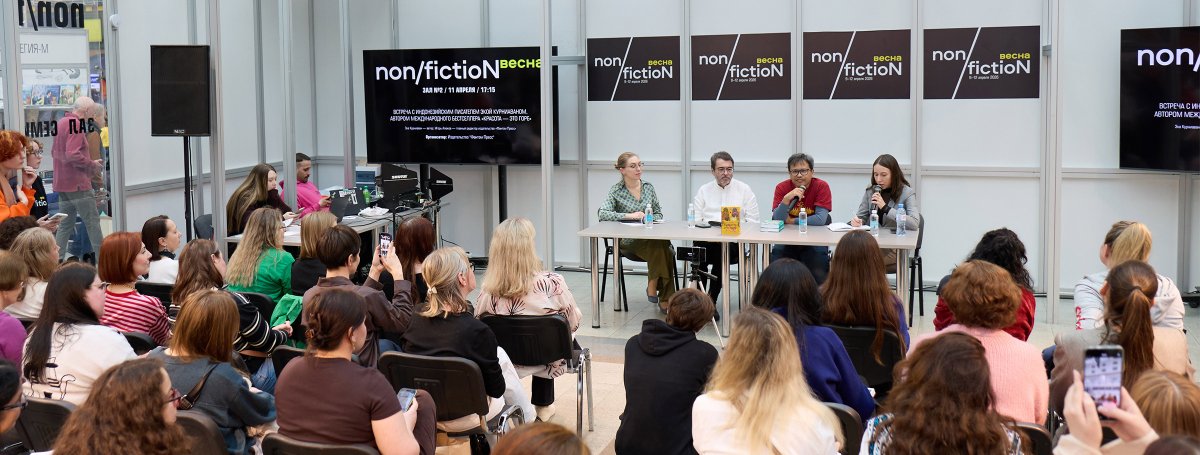
During his visit to the Russian capital, Eka Kurniawan met students and lecturers from the Institute of Asian and African Studies at Moscow State University, professionals in the field of Indonesian language and culture, and took part in the Non/Fiction 2026 international book fair, where he engaged with his readers.
The visit of Eka Kurniawan, the author of the book Beauty Is a Wound published in Russia, was organised by Intersputnik and Russian Satellite Communications Company, Signatory of the Organization from Russia. This visit was made in the framework of expanding mutual multicultural interaction with the peoples of the world and promoting the idea of equal and open cooperation in all areas of human activity. Today, the novel Beauty Is a Wound is the most famous Indonesian piece of writing, which has been translated into dozens of languages.
Eka Kurniawan was born in 1975 on the island of Java and studied philosophy at Gadjah Mada University. A journalist and screenwriter, he is the first Indonesian author to receive international recognition and be nominated for the Booker Prize. His works are often compared to Marquez, Rushdie and Bulgakov. The elements of magical realism he uses in his works are not literary decoration or a tribute to fashion, but a tool that allows the author to aptly narrate intricate human stories against the background of the country’s history. “I grew up listening to fairy tales, myths and folk stories. They are always a mixture of the real and fantastic, and for me it’s a natural way of storytelling,” Eka Kurniawan said in one of his interviews.
As an international organisation, Intersputnik is actively working on projects to strengthen human resources and support young professionals in the satellite communications industry, which is impossible without taking into account regional cultural traits. Intersputnik pays special attention to the Asia-Pacific region (APAC), where the satellite industry is one of the most highly-demanded and promising.
In February 2025, Intersputnik joined the Asia-Pacific Space Community Council (APSCC), a leading regional association uniting the largest players in the satellite market in the Asia-Pacific region. In May 2025, the joint 53rd session of the Board and the 28th session of the Intersputnik Operations Committee were held in Laos.
The Organization is also actively developing partnerships with leading industry educational centres in APAC. In early 2026, Intersputnik signed a memorandum of understanding with the aim of developing cooperation in building capacity in the field of space communications with leading higher education institutions in Indonesia: Universitas Telkom, Universitas Ahmad Dahlan and Universitas Islam Indonesia.
Geographically, Indonesia is an archipelagic country consisting of 17,000 islands (of which more than 6,000 are inhabited) located in a seismically active zone. Therefore, satellite communications and broadcasting systems are key for the country in maintaining a common information space and ensuring citizens’ access to modern digital services and information. The first geostationary communications and broadcasting satellite for the Indonesian state operator was put into operation in 1976. Thus, Indonesia was the third country – after the USA and the USSR – to begin creating its own geostationary constellation of communications and broadcasting satellites. Today, Indonesia is implementing a program to achieve ambitious goals in the space industry by 2045 to ensure sovereignty and economic growth (the Golden Indonesia 2045 vision). At various international forums, Indonesian representatives have repeatedly emphasised the important role that satellite technology plays in the country’s development, as well as the need for cooperation with international satellite operators.
By working closely with other international organisations and contributing to the achievement of the UN Sustainable Development Goals through its activities, Intersputnik clearly recognises that comprehensive, multifaceted international cooperation must develop not only in the field of satellite communications and high technology, but also encompass the cultural sphere. International projects in the humanitarian field promote the interpenetration of cultures and the education of modern people based on the principles of mutual respect and the ability to understand each other.
Eka Kurniawan’s visit to Moscow set an example for Intersputnik of how to foster a general atmosphere of trust and equal international cooperation in the interests of the Organization’s Member States.